How reviews work
Choose a scope and review kind, estimate the work, inspect findings and keep the results in the repository.
Explore the review workflow →Quality Studio connects code, findings and recorded review evidence in one workspace. Run reviews by scope and kind, inspect the reasoning, and version the results with your repository.
building in the open · library, CLI, API, and browser ship from one repository · nothing published to NuGet yet · Apache 2.0
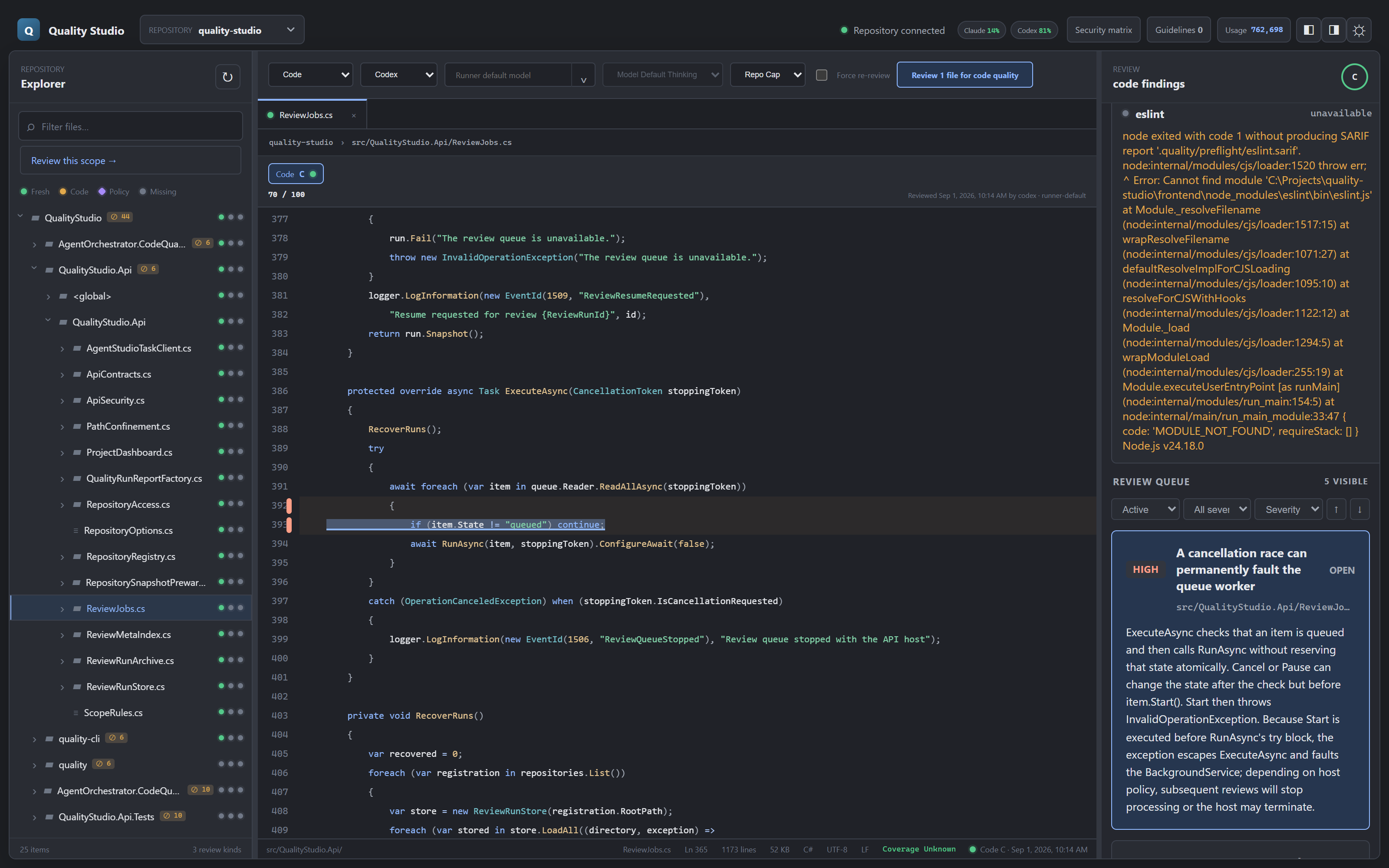
Code, review status and findings share one workspace. Move from the explorer to the affected file and the reasoning behind a finding.
The derived hierarchy with one chip per review kind on every node: review state at a glance, grade on hover, filterable by state.
The file itself, with review overlays rendered at the code. Switching kind or aspect changes the overlay, never the file.
Aspect-split findings with severity, evidence anchors into the source, and a lifecycle: open, accepted, waived, false-positive, resolved.
A to F per unit and kind, with a written rationale. A file review is never collapsed into a single good-or-bad badge.
From the first review to an informed decision: workflows, criteria and model choices.
Choose a scope and review kind, estimate the work, inspect findings and keep the results in the repository.
Explore the review workflow →33 named rules and 6 metrics, with rationale, examples, formulas and explicit limits.
The complete rule library and metric explanations have their own directly linkable page, with an auditable source snapshot.
Explore criteria and metrics →Current review models, historical choices and links to dated pricing and benchmark evidence.
Explore model choices →Everything runs against a plain checkout. The analysis core is a packable library (nothing is published yet); the quality CLI drives scans, reviews, diffs, and reports; the API serves the tree, the overlays, the runs, and the usage; reports are exported as Markdown, HTML, JSON, or SARIF 2.1.0 with CI gates.
quality scan fails on stale reviews, quality diff --fail-on-regression on deterministic regressions, quality report --fail-under / --fail-on on score or severity — and the report is still published before the gate fails.
Grades per kind and level, finding counts by severity and lifecycle, fresh/stale/drift/missing distribution, file coverage, sensor posture. Missing coverage is visible, not a passing grade.
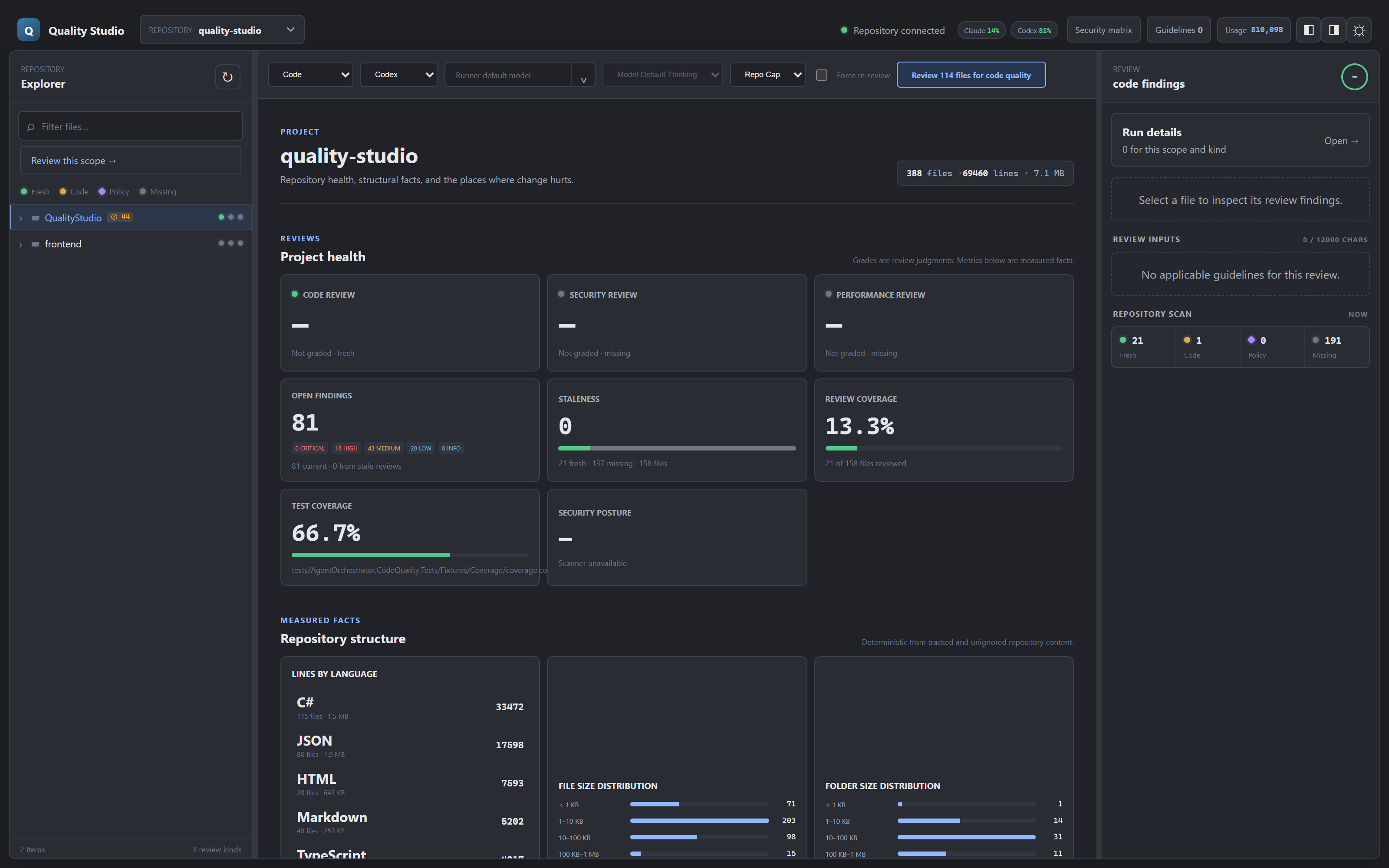
Quality Studio stays the engineer room. When a finding needs action, “make this a task” hands a lossless snapshot to Agent Studio through its normal task mutation path — one direction, no embedded quality dashboard in the cockpit, and a backlink for the way back.
The Agent Orchestrator universe: cockpit, runner, chat, accounting →Founded 2026-07-11. Core library, CLI, review API, and the Angular browser ship from one repository and are covered by CI. Open research is labeled as research: whether a code graph joins as a graphical meta layer is a time-boxed spike, not a decision. This page describes what exists.
Repository, concept, and slice plan on GitHub ↗